

The Engineering Leadership Gap: Why Industrial Expansion Depends on the Right People
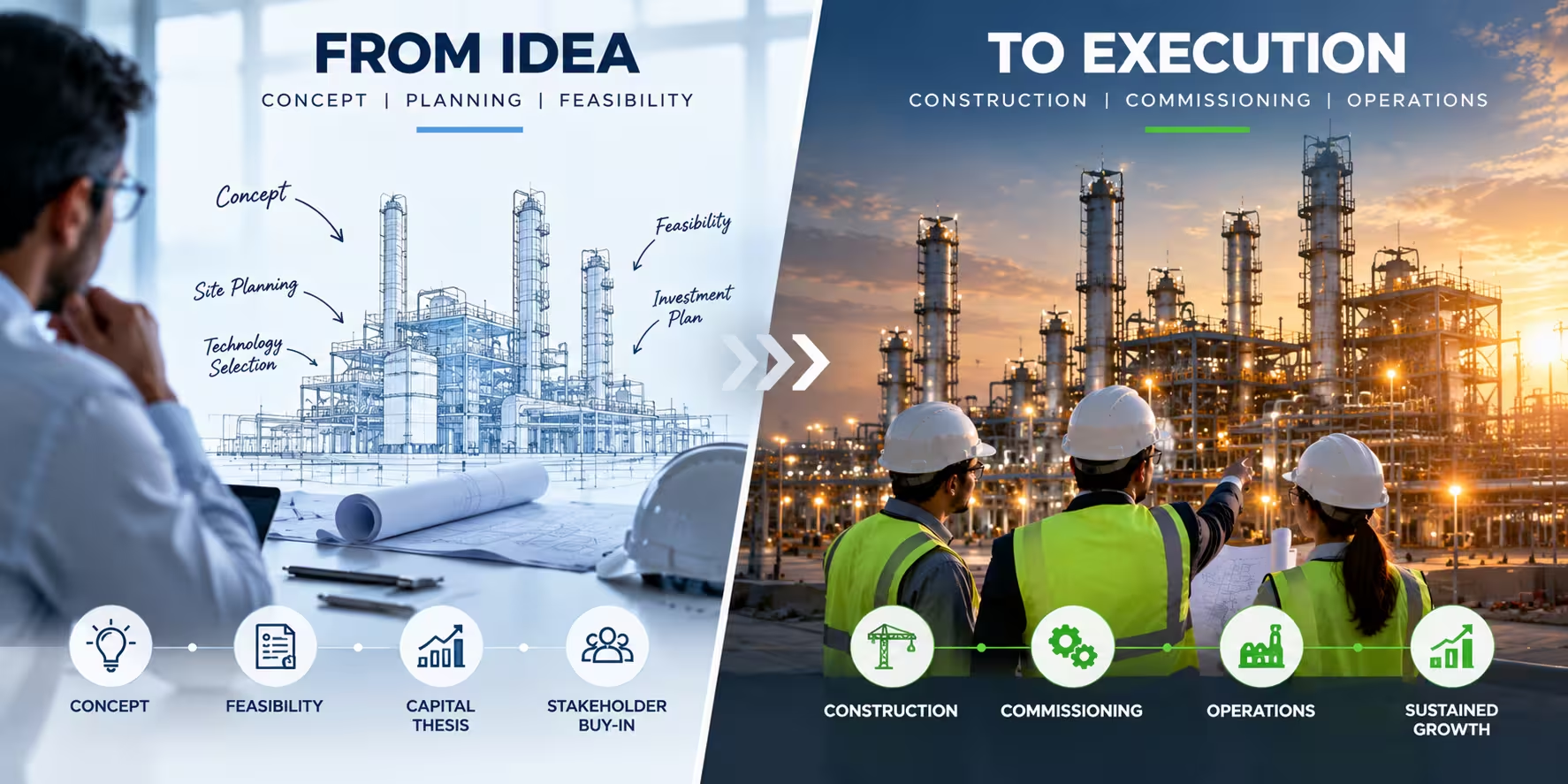
Industrial ambition is rarely limited by ideas. Regions and companies are full of plans for new plants, value-addition facilities, manufacturing hubs, and technology-enabled production sites. What separates projects that reach construction from those that remain on paper is often not the concept or even the capital thesis. It is the people who can turn the plan into a buildable, fundable, and operable reality.
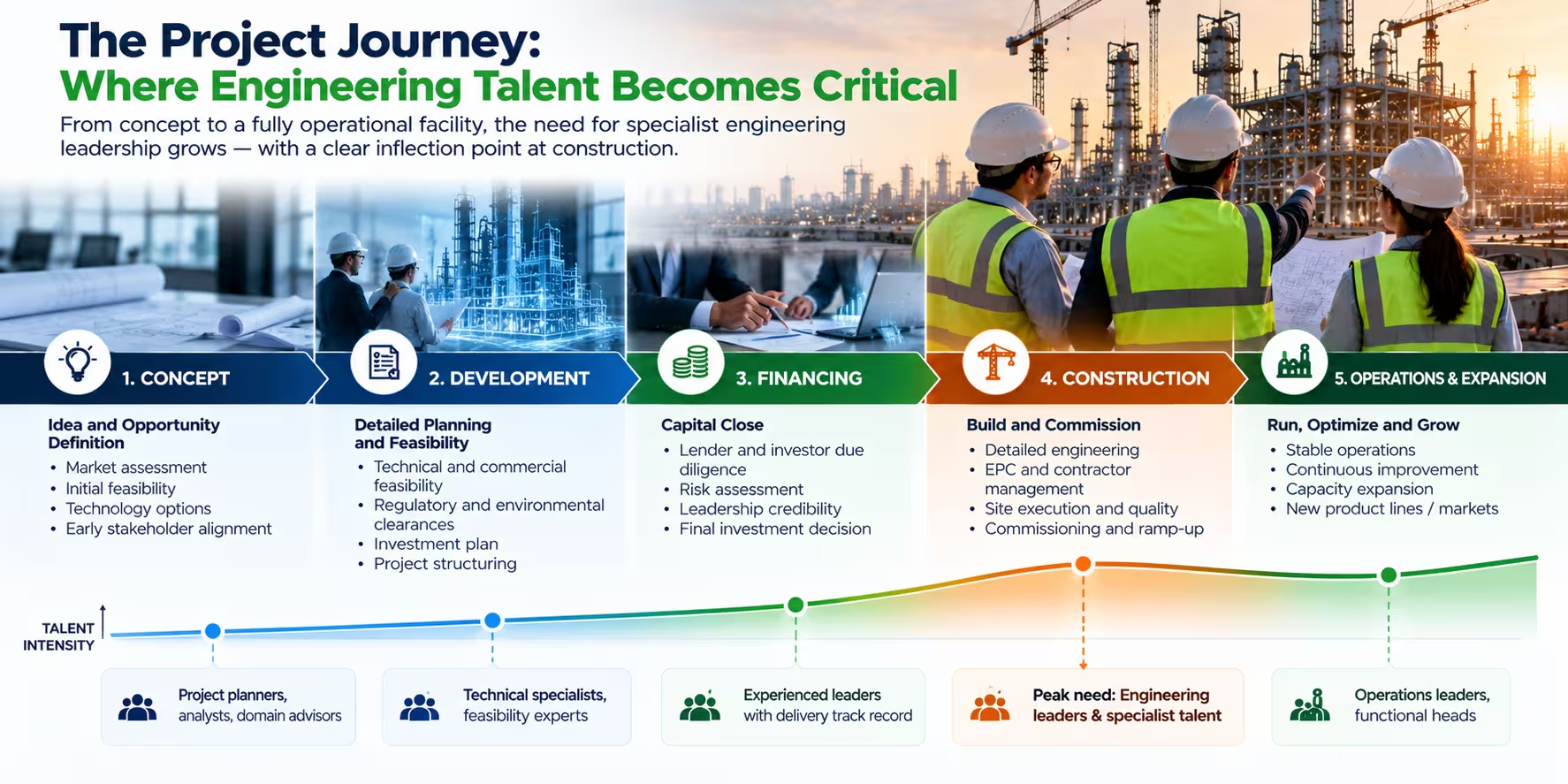
As projects move from development into execution, a different kind of capability is required. That transition is where many industrial expansions slow or stop. The gap is not only operational. It is an engineering leadership gap.
Ideas Are Abundant. Execution Is Scarce.
In industrial development, the pattern is familiar. A strong concept is defined. Feasibility work advances. Early stakeholders commit. Then the project must prove it can be delivered: on schedule, within a manageable cost envelope, and under leadership that lenders and partners trust.
At that stage, the questions change. Can the organization actually build it? How will cost overruns be managed? Who is leading the work? Capital does not invest in slides. It invests in the institution and the people behind delivery.
Founders and early teams often bring exposure—insight into the opportunity, the market, and the technology path. What funders and partners increasingly look for is experience: a delivery record, specialist depth, and a leadership structure that can function beyond any single individual.
Why the Gap Widens at Construction
During early development, many organizations recruit effectively through personal networks and known industry contacts. Storytelling and vision still carry weight. Construction and scale-up change the requirements.
The project needs specialists who understand complex plant design, process engineering, functional safety, commissioning, industrial automation, quality systems, and the practical realities of bringing a facility online. It needs technical leaders who can own interfaces between engineering firms, contractors, operations, and the business. Those profiles are rarely sitting inside the founder’s immediate circle.
Organizations that are not recruitment specialists often discover this late. They know they need the capability. They do not know where the right people are, how to assess them, or how to secure them before the schedule becomes irreversible.
That is the engineering leadership gap in practical terms: the distance between the ambition to expand industrially and the specialist leadership and talent required to execute when the project becomes real.
What “the Right People” Actually Means
Closing the gap is not only about headcount. It is about the right mix of roles and judgment at the right stage.
Technical leadership that can own delivery
Interim or permanent engineering leaders who have taken comparable facilities or production systems through design, construction, and ramp-up. They reduce key-person risk and give external stakeholders confidence that decisions will continue even as the organization grows.
Specialist engineering depth
Process, mechanical, electrical, automation, functional safety, industrial AI, and related disciplines that match the technology and regulatory environment of the plant or product line. Generalist hiring rarely substitutes for this depth once construction and commissioning begin.
Leaders who can work across boundaries
Industrial projects fail at interfaces: between the owner and the EPC, between design and operations, between global standards and local execution. Leaders who can manage those boundaries are as critical as pure technical experts.
A structure that does not depend on one founder
Decisions must be able to happen without a single individual. If people come and go, the institution should still be able to deliver. That requires deliberate leadership design, not only charismatic founding energy.
Implications for Leaders Expanding into New Markets
CEOs, founders, and COOs driving industrial expansion—whether a new plant, a greenfield manufacturing site, a capability center tied to production, or a technology-enabled industrial facility—face a predictable sequence of talent decisions:
- Map the transition early. The skills that sell the project are not always the skills that build it. Identify which leadership and specialist roles become critical at financing close and at the start of construction.
- Separate exposure from institutional experience. Where the organization lacks a delivery track record, it must borrow or buy it through partners, advisors, and senior hires who have already executed similar work.
- Treat specialist search as a project-critical workstream. Waiting until the construction schedule is under pressure compresses options and raises cost. Specialist engineering and leadership hiring should run in parallel with technical and financial workstreams.
- Build for continuity. The goal is not only to staff the peak of construction. It is to leave behind an operating organization that can run, improve, and expand the asset.
How Propellence Supports Industrial Expansion Leaders
Propellence works with engineering-led and industrial organizations on the leadership and specialist talent side of this problem. That includes boutique leadership hiring for CTOs, VP Engineering, engineering directors, and functional leaders, as well as access to domain experts through the Propellence Expert Network for advisory, validation, and interim mandates.
For leaders expanding capacity or entering new markets, the practical value is speed and precision in finding people who have already operated in comparable technical and industrial environments—across India, Europe, North America, and APAC—rather than relying only on general networks when the project can least afford delay.

Closing Perspective
Industrial expansion succeeds when ambition is matched by the engineering leadership and specialist capability required to execute. Ideas and capital open the door. The right people determine whether the plant, the line, or the facility actually gets built and runs.
Organizations that treat the engineering leadership gap as a core project risk—and address it with the same seriousness as financing and engineering design—improve their odds of moving from concept to construction to sustained operation. Those that leave it to informal networks often discover the gap only when the schedule and the lenders are already waiting.
To discuss leadership and specialist talent for an industrial expansion, contact Propellence.
Frequently Asked Questions
What is the engineering leadership gap in industrial projects?
It is the shortfall in specialist technical leadership and engineering talent that becomes critical as a project moves from development and financing into construction, commissioning, and operations.
Why do industrial ideas stall after financing?
Delivery depends on people with proven experience in building and running similar facilities. Founder networks and general hiring often cannot supply that depth at the speed the project requires.
When should companies start specialist leadership hiring?
Early enough that critical roles are identified and advanced before construction schedules lock in. Treating search as a late workstream increases risk and cost.
What roles matter most at the construction stage?
Technical leaders who can own delivery, plus specialists in process, automation, functional safety, quality, and related disciplines, depending on the technology and regulatory context.
How is this different from ordinary recruitment?
Industrial execution roles require domain-specific assessment and access to passive specialist talent. Organizations that are not specialist search firms frequently lack visibility into where those people are.